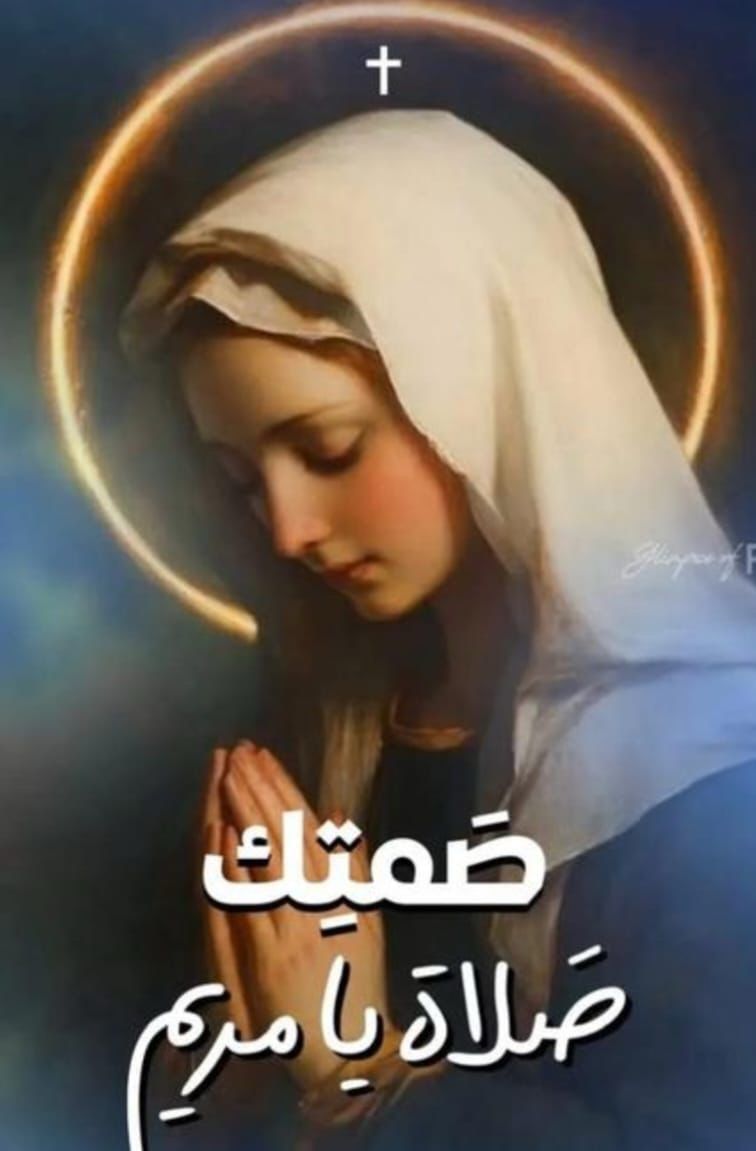
Votive Patina
Pray for us, and watch the picture wear. An object-detection model is pointed at a sacred image: it brackets the Virgin as a person, mislabels the holy as the mundane, and reads the prayer as a rectangle of text. Everything it misses is behind the click, the “+”, and the console. Nothing about you leaves this device - the prayer is written to your console, your storage, and this page’s source, and nowhere else.
Lossy JPEGs as votive patina
How faith travels as .jpeg in the sacred compression of family WhatsApp group chats.
I wake up to these images most mornings. My Christian mother in Lebanon forwards them on the family WhatsApp. Blessed JPEGs, if you will.
A low-res Virgin Mary surrounded by roses the color of expired candy. Jesus either emaciated under dramatic lightning or posing with freshly blown-out hair, post-resurrection. The Holy Spirit, always a dove. All of it looks like it was designed in Microsoft Paint circa 2003 and has somehow survived two decades. Lately AI has joined the game, and slop has never felt as sloppy as when the Virgin Mary is rendered as a Pixar child.
Digital apparitions
A few years ago, it hit me: these are apparitions. Not miracles, but their approximation - daily prayers, compressed. For migrants and their parents, these pixelated images have become new rosaries. Each forward pixelates the image further, softens an edge, corrupts a hue, proof that it has travelled, been seen, believed in. The lower the resolution, the more the picture was forwarded, the more eyes it has touched.
That decay is a kind of holiness. Saint Peter’s foot at the Vatican, worn smooth by centuries of kisses. Art historians call it votive patina or devotional wear. The Virgin my mother sends me each morning is a digital equivalent, a tactile shrine of pixels.
Faith as transmission
In this networked era, faith is no longer congregation, it’s transmission. Long-press → Forward is the new exchange of peace. Passing on these relics is the prayer. Barthes, in Camera Lucida, called it the punctum, the detail that pierces us beyond meaning. For me, it’s the compression halo around Mary’s face, the ghostly aura of digital decay. It tells me this image has migrated: from Tyre to Dubai to Paris to Detroit, and finally, to me in San Francisco. Like me, it has travelled. These images aren’t art objects; they’re acts. Not curated, but performed. Faith as a networked performance.
The silence as cathedral
My mother sends her JPEG at precisely 6:03 a.m. Neither my sister nor I reply. Even an emoji would break the spell. There’s choreography to this. Her predictability, our muted chat, the invisible thread of belief stretched across continents. That silence completes the image. It’s the shared cathedral of our family’s esoteric faith. When one of us finally reacts - a lone heart, a thumbs-up - that becomes the Eucharist.
Kitsch, camp, and care
Milan Kundera called kitsch the denial of everything unpleasant. These Marys are kitsch perfected, no irony, no doubt, only pink clouds and glitter fonts whispering “The Virgin blesses your morning.” Sontag might call it Camp, Byung-Chul Han might call it positive violence, the smoothing of contradiction. Maybe they’re right. But I still think something sacred is happening here. When my mother sends these images, she’s saying something she doesn’t know how to say:
My son, my daughter, I am aging. This faith is the buoy I know best. These worn images are the best way I know to say I love you.
And all this decoding, this media theory of Arab Jesus memes, is just my way of saying “I love you back”.
Votive Patina · net.art · e-lit · made in the kitchen lab · oulipo.xyz · halimmadi.com